Why Is My Pool Cloudy After Shocking? (2026 Troubleshooting Guide)
A pool cloudy after shock is rarely a sign of failure; rather, it is a transitional state in the purification process.
7/5/20266 min read
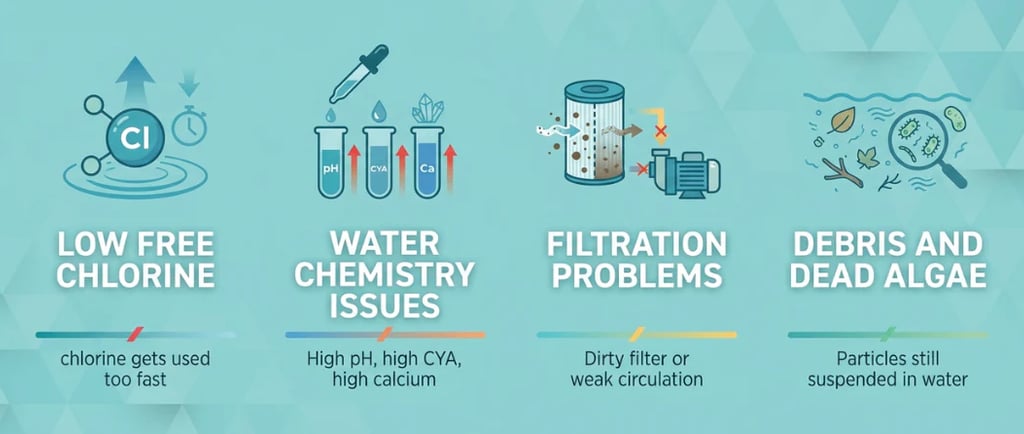
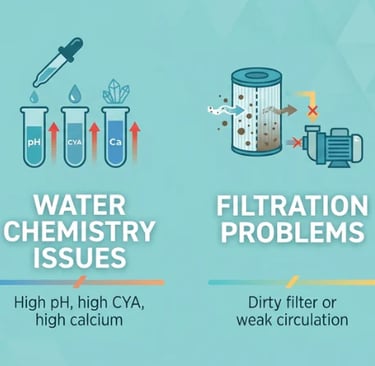
It is a common frustration for pool owners: you notice a slight dullness or organic buildup in your water, apply a heavy dose of chlorine to "sanitize and clear" the pool, only to wake up the next morning to a milky, opaque mess. This phenomenon, often referred to as the post-shock paradox, is one of the most frequent queries in pool water chemistry troubleshooting.
While shocking is an essential maintenance task designed to eliminate contaminants, the chemical process itself can trigger a series of reactions that temporarily compromise clarity. In 2026, with the advancement of automated sensing and precision chemistry, we have a much clearer understanding of why this happens and, more importantly, how to resolve it quickly. Whether you are dealing with calcium precipitation or the remnants of a successful algae kill, achieving a crystal-clear finish requires a balance of chemical correction and mechanical filtration.
Key Takeaways for Crystal Clear Water
Immediate Cause: Cloudiness is usually caused by high calcium hardness, pH imbalances, or suspended dead algae particles that are too small for standard filters to catch immediately.
Chemistry First: Always balance your pH and total alkalinity before and after shocking; high pH is the leading cause of "milky" water.
Filtration is Vital: Ensure your pool filtration system efficiency is at its peak by backwashing sand filters or cleaning cartridges to handle the increased debris load.
Modern Solutions: Utilizing a robotic pool cleaner for cloudy water can significantly accelerate the clearing process by providing supplemental micron filtration and constant circulation.
Timeline: Expect a recovery period of 12 to 24 hours with modern variable-speed pumps and robotic assistance, though older systems may take several days.
Why Is Your Pool Cloudy After Shocking?
Understanding why a pool turns cloudy pool after chlorine shock requires a look at the chemical reactions occurring beneath the surface. There are four primary culprits:
1. High Calcium Hardness and Precipitation
Many pool owners use Calcium Hypochlorite (Cal-Hypo) as their primary granular shock. While effective, Cal-Hypo adds calcium to the water. If your calcium hardness is already near the upper limit (above 400 ppm), the shock can push the water into a state of "over-saturation," causing calcium to precipitate out of the solution as tiny white particles. This results in a pervasive milky appearance.
2. Dead Algae Suspension
If you shocked the pool to kill an active algae bloom, the cloudiness is actually a sign that the treatment worked. When algae die, they lose their green pigment and turn a greyish-white. These microscopic organic remains often stay suspended in the water column because they are too light to settle and too small for a standard sand filter to trap without assistance.
3. pH and Total Alkalinity Spikes
Shocking agents, particularly liquid chlorine (sodium hypochlorite), have a very high pH. If the total alkalinity is not properly buffered, the shock treatment can cause the pool's pH to skyrocket. In high-pH environments, minerals like calcium become less soluble and "cloud out" of the water.
4. Cyanuric Acid (CYA) and "Pool Lock"
In the 2026 climate, where higher temperatures lead to increased evaporation, cyanuric acid (stabilizer) levels can become concentrated. If CYA levels exceed 100 ppm, it can lead to "chlorine lock," where your shock becomes ineffective, or "pool lock," where the high stabilizer content contributes to a persistent hazy appearance that is difficult to clear through filtration alone.
How Long Does the Cloudiness Last?
The duration of cloudy pool after shock depends heavily on your equipment's water turnover rate. In previous decades, a single turnover (moving the entire volume of pool water through the filter) could take 10 to 12 hours. With modern 2026 variable-speed pumps, we can optimize flow rates for maximum filtration efficiency.
High-Efficiency Systems: With a properly sized cartridge filter and a variable-speed pump running at optimal RPM, cloudiness should clear within 12 to 24 hours.
Legacy Systems: If you are using an older single-speed pump and a sand filter, the process may take 3 to 5 days, as sand filters generally have a higher micron filtration rating (trapping only particles 20 microns or larger).
Robotic Assistance: Adding an AI-driven robotic cleaner into the mix can often cut these times in half by providing localized filtration and preventing debris from settling.
Comparison: Clarifiers vs. Flocculants vs. High-Tech Filtration
When the water remains hazy, owners often choose between chemical additives or mechanical filtration.
| Feature | Pool Clarifier | Pool Flocculant (Floc) | Robotic Micron Filtration |
| :--- | :--- | :--- | :--- |
| Action | Coagulates tiny particles into larger clumps for the filter. | Bonds particles together and sinks them to the floor. | Active mechanical removal of particles via on-board filters. |
| Effort Level | Low - Let the filter do the work. | High - Must vacuum "to waste" manually. | Low - Automated "set and forget." |
| Water Loss | None. | Significant (due to vacuuming to waste). | None. | | Timeframe | 2-3 days. | 12-24 hours (plus labor). | 4-8 hours. |
| Best For | Mild haziness or routine maintenance. | Severe "marshmallow" clouds. | Dead algae removal and daily clarity. |
While pool clarifier and flocculant have their place, the 2026 standard for premium pool care has shifted toward high-capacity robotic pool cleaners. These devices bypass the main filtration system, removing the burden from your sand or DE filter and preventing the need to dump thousands of gallons of chemically treated water.
5 Steps to Fix Cloudy Pool Water After Shocking
If your pool is still hazy 24 hours after a shock treatment, follow this structured troubleshooting protocol:
Re-Test Water Chemistry: Use a 2026 digital pool water testing kit or a pool chemistry app to get an exact reading of your current levels. Do not rely on visual inspection or old test strips that may have degraded.
Balance pH and Alkalinity: High pH is the most common reason cloudiness won't clear. Target a pH of 7.2 to 7.4. This slightly acidic range helps minerals dissolve back into the water and makes the remaining free chlorine levels more active.
Optimize Filtration Efficiency: If you have a sand filter, perform a sand filter backwashing cycle. For cartridge filtration or DE filters, remove the elements and deep clean them. A clogged filter cannot trap the microscopic debris causing the cloudiness.
Engage Robotic Filtration: Deploy a robotic skimmer and floor cleaner. Modern robots offer micron filtration capabilities that can capture particles as small as 2 to 5 microns—far more efficient than most residential sand filters.
Maintain Oxidizer Levels: Ensure your free chlorine remains above 3 ppm. If it drops too quickly after shocking, you may be experiencing a "rebound" algae bloom, which will create a cycle of perpetual cloudiness.
The Role of Robotic Pool Cleaners in Pool Care
The industry has moved away from relying solely on the main pool pump for water clarity. Leading brands like Beatbot have introduced AI-driven models that serve as a secondary, mobile filtration plant. These robots are essential for solving how to fix cloudy pool water because they address the "dead zones" in a pool where water circulation is poor.
By constantly moving across the floor and climbing walls, these cleaners ensure that suspended dead algae and calcium precipitates are directed toward the filtration intake or captured within the robot's own internal canisters. High-end models in 2026 feature automated pool maintenance scheduling and sub-micron filtration, effectively acting as a portable water polisher that operates independently of the main pool filtration system efficiency.
Disadvantages and Reality Check: When Chemistry Isn’t the Problem
While chemical balancing and robotics solve most issues, it is important to recognize the limitations of these fixes. According to 2026 professional evaluation data (such as reports from leading pool industry trade journals), a significant percentage of persistent cloudiness is due to mechanical failure rather than chemistry.
Filter Channeling: In sand filters, "channels" can form where water bypasses the sand entirely, meaning the water is never actually filtered.
Environmental Impact: Over-using liquid chlorine or flocculants can lead to high salt levels or chemical runoff issues. Over-treating a pool with chemicals often creates a "chemical soup" that becomes increasingly difficult to balance.
System Sizing: If your pool volume is too large for your pump and filter's flow rate, no amount of shock will keep the water clear. You must respect the physical limits of the water turnover rate.
Conclusion: Maintaining a Pristine Pool
A pool cloudy after shock is rarely a sign of failure; rather, it is a transitional state in the purification process. By understanding the interaction between calcium hardness, pH, and filtration, you can navigate the post-shock haze with confidence.
The key to a pristine pool in 2026 is proactivity rather than reactivity. Utilizing automated pool maintenance tools—such as digital sensors that alert you to pH spikes before they cause precipitation, and robotic pool cleaners that provide constant, fine-tuned filtration—ensures that cloudiness is a temporary inconvenience rather than a season-long struggle. Keep your chemistry balanced, your filters clean, and your technology engaged for a crystal-clear swimming experience.
Contact
Questions? Reach out anytime here.
Phone
lilily2023888 [@] gmail [dot] com
contact me and cooperation
© 2025. All rights reserved cleanerpoolrobot.