Ultimate Guide to Automatic Pool Cleaners for Inground Pools
This guide examines how AI-powered pool maintenance is redefining luxury and engineering precision in 2026.
INGROUND POOLS
Mike Wu
7/5/20265 min read
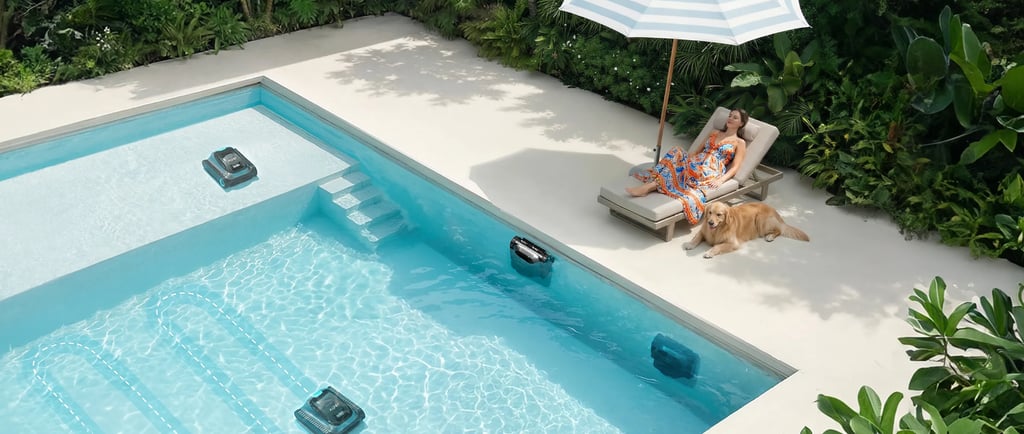
The landscape of residential pool care has undergone a radical transformation. As of 2026, the transition from traditional, tethered pressure-side cleaners to autonomous, AI-powered systems is nearly complete. The modern inground pool owner no longer seeks a mere vacuum; they demand a comprehensive robotic steward capable of managing the entire aquatic environment. This shift is headlined by the rise of the cordless robotic pool cleaner, a category that has evolved from a niche luxury to the industry standard. Leading the charge are 5-in-1 systems—such as the Beatbot AquaSense Pro—which consolidate floor scrubbing, wall climbing, waterline scouring, surface skimming, and water clarification into a single, "set-and-forget" workflow. This guide examines how AI-powered pool maintenance is redefining luxury and engineering precision in 2026.
Key Takeaways
Cordless Dominance: Lithium-ion battery life and brushless motor efficiency have rendered power cords obsolete in premium 2026 models.
Integrated Intelligence: AI navigation maps and ultrasonic sensors have replaced the "random bounce" patterns of previous decades, ensuring 100% coverage.
5-in-1 Versatility: Flagship units now treat the water surface and chemical balance, moving beyond simple debris collection.
Smart Integration: Hands-free maintenance is facilitated through high-performance filtration and real-time smart app integration for scheduling and firmware updates.
The Evolution of AI-Powered Pool Maintenance
The fundamental challenge of any automatic pool cleaner for inground pools has historically been coverage. In 2026, the industry has solved this through the intersection of robotics and spatial computing. Modern smart inground pool vacuum systems utilize advanced ultrasonic sensors to map the pool's geometry in three dimensions. This AI navigation map allows the robot to calculate the most energy-efficient path, significantly reducing the cleaning time compared to older gyroscopic models.
This evolution is underpinned by the move to brushless suction motors. Unlike traditional motors, these units operate with minimal friction, delivering higher torque while consuming less power. This efficiency is critical for maintaining high-performance filtration without draining the battery prematurely. Furthermore, hydrodynamic design has been refined to ensure that as the robot moves, it creates a downward force, increasing all-terrain traction on slippery tile and vinyl surfaces. This combination of hardware and AI-powered pool maintenance ensures that even the most complex geometric pool designs receive a systematic, edge-to-edge clean.
Advanced Cleaning Features: Beyond the Floor
While floor cleaning is the baseline requirement, the 2026 generation of cleaners focuses on the "totality of the pool." A premium automatic pool cleaner for inground pools now employs a dual-brush system designed for heavy scrubbing. These brushes rotate at different speeds to dislodge stubborn algae and calcium deposits before the high-performance filtration system sequesters the debris.
The most significant advancement in recent years is the refinement of the wall-climbing robot capability. Utilizing variable suction technology, these units can transition from the floor to the walls seamlessly, performing dedicated waterline scrubbing. This is the area most prone to "pool ring" buildup, and 2026 models use specialized AI pathing to spend extra time at the surface interface.
Furthermore, the introduction of the integrated pool chemical dispenser has changed the maintenance paradigm. Devices like the Beatbot AquaSense Pro can now dispense a water clarification agent during the cleaning cycle, ensuring that microscopic particles too small for the filter are coagulated and captured. Once the cycle is complete, the automatic return to surface feature uses buoyancy control to bring the robot to the waterline for effortless retrieval, eliminating the need to "fish" for the device with a hook.
Head-to-Head Comparison: Beatbot AquaSense Pro vs. Industry Rivals
In 2026, the market is defined by three primary contenders: the Beatbot AquaSense Pro, the Maytronics Dolphin Liberty series, and the Aiper Scuba flagship. While all offer cordless convenience, the technological gap lies in the cleaning modes and navigation precision.
| Feature | Beatbot AquaSense Pro | Maytronics Dolphin (2026 Ed.) | Aiper Scuba S1 Pro | | :--- | :--- | :--- | :--- | | Cleaning Logic | 5-in-1 (Incl. Surface/Clarity) | 3-in-1 (Floor/Wall/Waterline) | 3-in-1 (Floor/Wall/Waterline) | | Navigation Tech | Ultrasonic + AI Mapping | Infrared + Gyroscope | Dual-Laser Pathing | | Suction Power | 5500 GPH | 4500 GPH | 4000 GPH | | Max Battery Life | Up to 9.5 Hours (Surface) | Up to 4.5 Hours | Up to 4.0 Hours | | Surface Skimming | Integrated (Propulsion-driven) | Not Available | Optional Attachment | | Chemical Care | Yes (Clarification) | No | No |
According to 2026 professional evaluation data from outlets like CNET and PCMag, the Beatbot AquaSense Pro remains the only unit to successfully integrate surface skimming as a primary function. While rivals focus on the floor and walls, the AquaSense Pro utilizes its propulsion system to clear floating debris before it sinks, significantly reducing the load on the pool's main filtration system.
Disadvantages, Limitations, and Reality Check
Despite the technological leaps, no automatic pool cleaner for inground pools is without its drawbacks. The primary barrier is the high entry price, which can range from $1,500 to $2,500 for flagship models. This is a significant investment compared to traditional suction-side cleaners.
Technical limitations also persist:
Weight Factors: When filled with water and captured debris, these units can weigh over 35 lbs. While the automatic return to surface feature helps, the physical lift out of the water still requires moderate strength.
Maintenance of the Maintainer: The phrase "hands-free maintenance" is a slight misnomer. Users must still manually empty the debris filtration system and clean the filter ultra-fine canisters to prevent odors and maintain suction.
Battery Longevity: While lithium-ion battery life is excellent for the first 3-4 years, chemical exposure and heat lead to inevitable degradation. Replacement battery packs are often proprietary and expensive.
Navigation Anomalies: Even with advanced AI, certain custom features like "beach entries" (zero-entry slopes) or extremely tight radius tanning ledges can occasionally confuse the all-terrain traction sensors.
2026 Buyer’s Guide: Choosing the Right Automatic Cleaner
Selecting the optimal cordless robotic pool cleaner requires an objective assessment of your pool's specific environment.
Debris Profile: If your pool is surrounded by deciduous trees, a model with a large debris canister and surface skimming capabilities is mandatory. If your primary issue is fine silt or sand, prioritize a unit with a high-performance filtration system (down to 2 microns).
Pool Material: Owners of tiled pools should ensure the robot features specialized brushes and high-traction treads to prevent slipping during waterline scrubbing.
Connectivity: In 2026, smart app integration is no longer a gimmick. It is the primary vehicle for "over-the-air" (OTA) firmware updates that improve AI path optimization over time. It also allows for custom "spot-cleaning" via remote control features.
Runtime vs. Recharge: Ensure the battery life exceeds the time required for a full deep-clean of your specific pool volume. A 9.5-hour runtime is ideal for larger estates, whereas a 3-hour charge may suffice for standard residential pools.
Conclusion
The evolution of the automatic pool cleaner for inground pools represents a broader trend in the smart home ecosystem: the move toward invisible, high-performance utility. By integrating AI navigation, cordless freedom, and multi-function cleaning cycles, devices like the Beatbot AquaSense Pro have effectively removed the "chore" from pool ownership. While the initial investment is substantial, the long-term savings in manual labor, reduced chemical consumption, and extended pool equipment life make these robotic systems an essential component of the modern luxury lifestyle.
Frequently Asked Questions (FAQ)
How long do cordless pool cleaner batteries last in 2026? High-end lithium-ion batteries are designed for 1,000 to 1,500 charge cycles. In practical terms, this equates to 4-6 years of regular use before a noticeable drop in runtime occurs.
Can AI cleaners handle beach-entry pools? Most 2026 models use water-pressure sensors to detect "out-of-water" events. While they can handle shallow areas, zero-entry slopes can occasionally trigger a "return to deep water" safety protocol.
Is the water clarification agent safe for all liners? Yes. Manufacturers formulate these agents to be pH-neutral and compatible with vinyl, fiberglass, and pebble-tec finishes. They are generally safer than manual "shocking" because they are dispensed in controlled, micro-doses.
How often do I need to update the AI navigation map? The robot updates its map in real-time during every cycle. However, firmware updates via the smart app are typically released quarterly to refine obstacle avoidance and energy efficiency.
Contact
Questions? Reach out anytime here.
Phone
lilily2023888 [@] gmail [dot] com
contact me and cooperation
© 2025. All rights reserved cleanerpoolrobot.