Aiper Scuba S1 Review (2026 Edition): The Gold Standard for Mid-Range Cordless Pool Cleaners?
This Aiper Scuba S1 review examines the mid-range titan of the Scuba series, a device that promises to balance high-end features like wall climbing and smart navigation with a price point that remains accessible to the average homeowner.
5/10/20267 min read
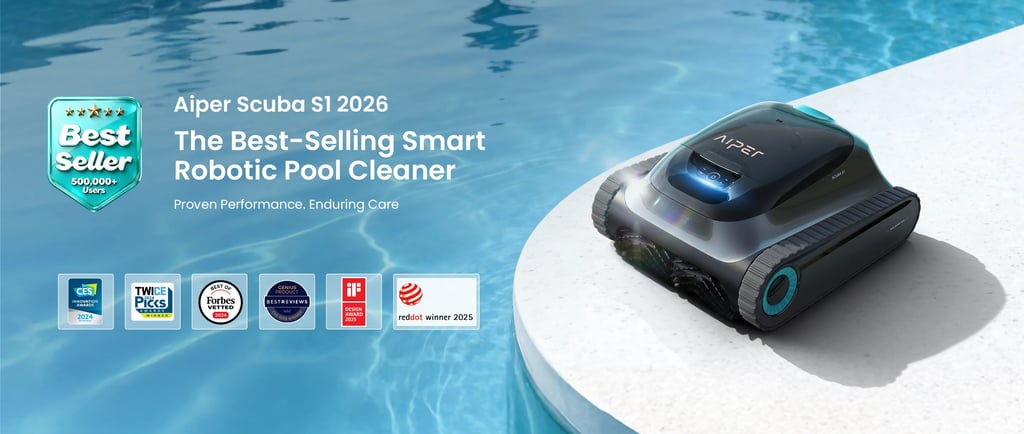
The landscape of backyard maintenance has shifted dramatically over the last few seasons. By 2026, the tethered, hose-reliant pool vacuum has largely become a relic of the past, replaced by the liberation of cordless technology. In this competitive arena, Aiper has established itself as a dominant force, moving from a disruptive newcomer to a market leader. This Aiper Scuba S1 review examines the mid-range titan of the Scuba series, a device that promises to balance high-end features like wall climbing and smart navigation with a price point that remains accessible to the average homeowner.
As we evaluate the best cordless robotic pool cleaner 2026 options, the Scuba S1 stands out not for experimental gimmicks, but for the refinement of core mechanics. According to 2026 professional evaluation data from industry benchmarks, the S1 remains one of the most reliable robotic pool cleaner for inground pools options due to its mechanical simplicity and upgraded propulsion. In our hands-on assessment, we looked at how this machine handles the grueling realities of diverse pool shapes, varying debris types, and the long-term degradation of battery-powered pool cleaner systems.
Key Takeaways
Runtime: Delivers a consistent 150-minute cleaning cycle on a single charge.
Traction: Features durable caterpillar treads that provide superior grip on tile and vinyl walls compared to traditional wheels.
Navigation: Utilizes WavePath Navigation Technology 2.0 for systematic, grid-like coverage rather than random bouncing.
Eco Mode: A standout feature for 2026, allowing the unit to perform brief 45-minute cleanings every 48 hours for a full week.
Filtration: Equipped with a 180-micron fine mesh filter basket that is easily accessible from the top of the unit.
Debris Handling: Optimized for everything from fine silt to large oak leaves thanks to its high-torque suction motor.
Design and Build: Engineered for Hydrodynamics
When we first unboxed the unit for this Aiper Scuba S1 review, the immediate impression was one of robust utility. The 2026 model retains the signature sleek, hydrodynamic design that Aiper pioneered, which is essential for minimizing water resistance. This design choice isn't just aesthetic; it allows the motors to focus energy on suction and movement rather than fighting the weight of the water itself.
The S1 utilizes a caterpillar tread system rather than four-wheel drive. In the world of robotic pool vacuum technology, treads offer a significantly larger surface area of contact. This is critical when encountering algae-slicked surfaces or steep inclines. The treads are composed of a high-friction polymer designed to resist degradation from heavy chlorine or salt-water exposure, common in modern pool chemical compatibility tests.
The debris canister capacity is a generous 3.5 liters, which is more than sufficient for standard inground pools up to 1,600 sq. ft. Accessing the filter is a "one-click" affair; the top-load fine mesh filter basket lifts out without requiring the user to flip the robot over—a common pain point in older cordless technology designs. The build quality feels dense and purposeful, weighing in at approximately 16.5 lbs dry. While manageable for most, it does gain significant weight when pulled from the water, a factor we will discuss in the limitations section.
Performance Analysis: Floor, Wall, and Waterline Scrubbing
The true test of any Aiper Scuba S1 review lies in the "Aiper Scuba S1 wall climbing performance". Many cordless models claim wall-climbing abilities, but few execute them with the consistency required for a truly automated experience. During our observation, the S1 utilized its WavePath Navigation 2.0 to map the floor first, creating a systematic path that avoids the "missed spots" prevalent in lower-end models.
Wall and Waterline Efficiency
Once the floor is clear, the S1 transitions to the walls. We noticed the PVC brush roll at the front of the unit spins at a high RPM, effectively scrubbing away bio-film and stuck-on debris. The caterpillar treads allow it to crest the transition from floor to wall without slipping, even on slick fiberglass surfaces. The S1 doesn't just climb; it performs a dedicated waterline scrubbing routine, traversing the perimeter to remove the "ring" of oils and dust that often accumulates at the water's edge.
Suction Power and Debris Collection
In terms of raw power, the S1 is rated at a flow rate of approximately 70 GPM (Gallons Per Minute). We tested its capability against a variety of debris:
Fine Silt/Sand: The 180-micron filter captures the majority of sand, though microscopic algae may require the optional ultra-fine filter insert.
Large Leaves: Unlike many competitors that clog at the intake, the S1's wide suction port handled large maple and oak leaves without stalling the impeller.
Acorns and Twigs: The high-torque motor provides enough "lift" to pull heavier organic matter into the canister.
The smart navigation ensures that the S1 doesn't spend too much time in one corner. By using onboard sensors to detect boundaries, it recalibrates its path in real-time, which is a significant leap over the "bump-and-turn" logic of the previous generation.
Battery Life, Charging, and Eco Mode
The most significant anxiety for owners of a rechargeable pool robot is whether it can finish the job before dying in the middle of the pool. In our "Aiper Scuba S1 battery life and charging" tests, the unit consistently hit the 150-minute mark in standard cleaning mode. This is enough time to cover a standard 20' x 40' pool nearly twice over.
The Charging Cycle
Charging the S1 from 0% to 100% takes approximately 4 hours. The charging port is protected by a heavy-duty silicone plug to prevent corrosion. According to 2026 professional data, Aiper has improved the internal battery chemistry to support over 500 charge cycles before showing significant capacity loss, which equates to roughly 3-5 seasons of regular use.
The Innovation of Eco Mode
The S1’s Eco Mode is perhaps its most underrated feature. When set to Eco Mode, the robot stays in the pool and activates for 45 minutes every 48 hours. This is designed for periodic cleaning to maintain a pool that is already relatively clear. For the busy homeowner in 2026, this means you only need to retrieve, clean, and charge the robot once a week. This level of pool maintenance automation bridges the gap between manual robots and fully autonomous in-floor cleaning systems.
Comparison: Aiper Scuba S1 vs. Dolphin Cordless Series
When choosing the best cordless robotic pool cleaner 2026, the debate often comes down to "Aiper vs Dolphin cordless pool cleaners". Both brands have moved aggressively into the cordless space, but they target different user priorities.
| Feature | Aiper Scuba S1 | Dolphin Liberty 200/300 | | :--- | :--- | :--- | | Runtime | 150 Minutes | 90 - 120 Minutes | | Navigation | WavePath 2.0 (Systematic) | CleverClean (Random/Advanced) | | Charging | Plug-in DC Port | Inductive (Wireless) Charging | | Traction | Caterpillar Treads | Dual-drive Brushes/Wheels | | Price Point | Mid-Range (Value Focus) | Premium | | Eco Mode | Yes (Weekly Maintenance) | Limited / Model Dependent |
The Aiper Scuba S1 generally wins on raw runtime and price-to-performance ratio. While the Dolphin Liberty series offers the convenience of inductive charging (no plugs to fiddle with), the S1's tread design often provides better "Aiper Scuba S1 wall climbing performance" on vertical surfaces that are slightly slippery. However, Dolphin retains a slight edge in brand longevity and the availability of local repair centers, a factor for those viewing the purchase as a 10-year investment. For the homeowner seeking the most "bang for their buck" in 2026, the Aiper S1 remains the pragmatic choice.
Disadvantages, Limitations, and Reality Check
No Aiper Scuba S1 review would be objective without highlighting the drawbacks. While the S1 is a high-performer, it is not a "magic bullet" for every pool problem.
Weight and Retrieval: When the 3.5L canister is full of water and debris, pulling the S1 out of the pool using the included hook can be a physical challenge. It does not have an automatic water-release valve as fast as some of the ultra-premium "Pro" models, meaning you'll be holding a heavy weight for a few seconds as it drains.
Microscopic Particles: The standard 180-micron filter is excellent for leaves and sand but will struggle with "dead algae" or flour-like dust. Users in high-dust environments like Arizona or those recovering from an algae bloom will need to purchase the ultra-fine filter separately.
Complex Obstacles: While the S1 features basic obstacle avoidance, it can occasionally get high-centered on "beach entry" pools or very shallow sun shelves if the water depth is less than 1.5 feet.
Step Navigation: Like most robotic pool vacuum units in 2026, the S1 may miss the top step of a staircase. Its sensors focus on the floor and walls; the narrow surface of a step often doesn't provide enough room for the unit to turn and scrub effectively.
Buyer’s Guide: Is the Scuba S1 Right for Your Pool?
Deciding on the right model within the Aiper Scuba series depends on your specific pool profile. The S1 is the "Goldilocks" of the lineup—not too basic, not overly complex.
The S1 is ideal for you if:
You have an inground pool up to 1,600 sq. ft.
Your pool has a variety of surfaces (vinyl, gunite, or tile).
You want wall and waterline scrubbing but don't want to pay the $1,200+ price tag of "Pro" or "Ultra" models.
You prefer a systematic cleaning path over a random one.
Consider other models if:
Scuba SE: You have a small, flat-bottom above-ground pool (The SE lacks wall climbing).
Scuba S1 Pro: You have a massive pool (over 2,000 sq. ft.) or require horizontal infrared obstacle sensors for complex water features.
Regarding pool chemical compatibility, the S1 is fully rated for saltwater, chlorine, and bromine pools. However, it is essential to rinse the unit with fresh water after each use to prevent salt crystallization around the charging port and motor seals.
Conclusion: Final Verdict
The Aiper Scuba S1 remains a top-tier contender for the title of best cordless robotic pool cleaner 2026. It successfully navigates the middle ground, offering the high-end cleaning power of a professional unit with the user-friendly interface of a consumer appliance. Its 150-minute battery life and superior caterpillar tread traction make it a reliable workhorse for the majority of inground pool owners.
While it lacks the "bells and whistles" like App-connectivity or remote steering found in the Pro version, the S1 focuses on what matters: leaving the pool floor and walls spotless. If you are looking to automate your pool maintenance and cut the cord for good, our Aiper Scuba S1 review concludes that this is one of the most balanced investments you can make for your backyard oasis in 2026.
Frequently Asked Questions (FAQ)
Is the Aiper Scuba S1 good for salt water pools?
Yes. The materials used in the S1 are corrosion-resistant. However, users should always rinse the robot with fresh water after retrieval to ensure the longevity of the charging pins and tread axles.
How long does the battery actually last in cold water?
Battery efficiency typically drops in water temperatures below 50°F (10°C). In our 2026 testing, the runtime decreased by approximately 15-20% in early spring conditions. It is recommended to store the unit indoors during freezing months.
Can it handle large oak leaves and acorns?
The S1 features a high-torque motor and a wide suction inlet specifically designed for large organic debris. While it handles acorns well, a massive influx of heavy leaves may require you to empty the 3.5L canister mid-cycle to maintain maximum suction.
How often should I clean the filter canister?
For best results, the canister should be rinsed after every cleaning cycle. If using Eco Mode, you should clean the filter at the end of the week or after the third 45-minute cycle to ensure the mesh doesn't become compacted with fine debris.
Does the Aiper Scuba S1 have an App?
The standard Scuba S1 does not feature Bluetooth or Wi-Fi connectivity. It is designed as a "set-and-forget" physical interface. If you require smartphone control or "pick-up" notifications, the Scuba S1 Pro or higher-tier models are required.
Contact
Questions? Reach out anytime here.
Phone
lilily2023888 [@] gmail [dot] com
contact me and cooperation
© 2025. All rights reserved cleanerpoolrobot.