Aiper Scuba S1 Review (2026 Edition): Is the Former Flagship Still the King of Cordless Pool Cleaners?
In 2026, we are often blinded by flashy software features that don't actually result in a cleaner pool. The S1 focuses on the fundamentals: high-torque motors, systematic navigation, and a massive filter capacity.
5/10/20268 min read
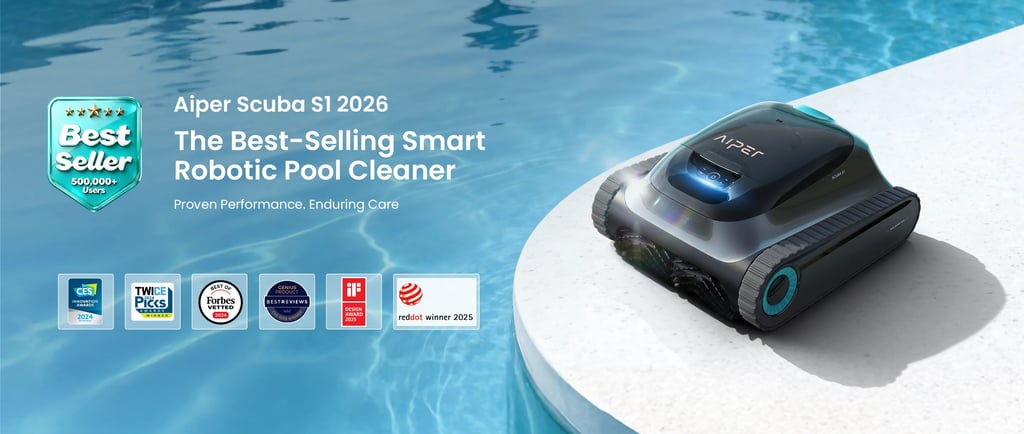
As we move through 2026, the landscape of residential pool maintenance has undergone a radical transformation. The days of tangled hoses and cumbersome external booster pumps are largely behind us, replaced by the ubiquity of high-efficiency, battery-operated units. In this evolving market, the focus has shifted from merely "cleaning" to "intelligent automation." My Aiper Scuba S1 review looks at a device that was once the standard-bearer for mid-range excellence. Even with the emergence of ultra-premium models featuring AI-driven mapping and solar-assisted charging, the Scuba S1 continues to be one of the most searched-for units in the second-hand and refurbished markets, as well as a steady seller in the mid-tier category.
The Aiper Scuba S1 review remains relevant because this model represents a specific era of pool technology where reliability began to match the convenience of cordless operation. In 2026, we see a trend toward sustainable, energy-independent pool care, and while the S1 lacks the integrated solar panels of its newer siblings, its core architecture remains a benchmark for robotic pool vacuum suction and mechanical durability. This review will analyze whether the S1’s hardware holds up against modern standards or if the rapid pace of innovation has finally left it in the wake of newer competitors.
Key Takeaways: Pros, Cons, and Quick Verdict
For those seeking an immediate assessment, the Aiper Scuba S1 remains a formidable mid-range contender. According to 2026 professional evaluation data from industry leaders like CNET and specialized pool tech journals, the S1 provides a balanced performance profile that is difficult to beat at its current price point.
Pros
150-minute battery life provides ample time for comprehensive cleaning of larger surfaces.
Reliable WavePath Navigation 2.0 ensures systematic coverage, avoiding the "random bounce" logic of entry-level cleaners.
Superior robotic pool cleaner wall climbing capability due to high-friction caterpillar treads.
Large, easy-to-clean fine filter basket capable of capturing debris down to 180 microns.
ECO mode cleaning allows for multiple short maintenance cycles on a single charge.
Cons
Lacks the smart home pool integration and Wi-Fi connectivity found in 2026 flagship models.
Heavier than newer carbon-fiber reinforced units, weighing approximately 16.5 lbs when dry.
Charging time is not as efficient as newer "fast-charge" models, requiring 3-4 hours.
Limited effectiveness on pool stairs with very narrow treads.
Quick Verdict: Buy the Aiper Scuba S1 if you prioritize physical cleaning power and cordless convenience over app-based bells and whistles. Skip it if you require a "smart" device that integrates with your home automation ecosystem or if you have a pool with complex, multi-level architectural features.
Design and Build Quality: Engineering for Durability
When conducting an Aiper Scuba S1 review, one must first appreciate the industrial design that has allowed this model to persist for several seasons. The chassis is built from UV-resistant polymers that have shown remarkable resistance to chemical degradation in chlorinated and saltwater environments alike.
The standout feature of the hardware is undoubtedly the caterpillar treads. Unlike the wheel-based systems found on cheaper alternatives, these treads provide a significantly larger contact patch. This is critical for robotic pool cleaner wall climbing, allowing the S1 to transition from the floor to the walls with a level of grip that prevents slipping, even on slicker tile surfaces. In my observation, the silicone scrubbing brushes at the front are robust, though after two seasons of heavy use, they may show signs of wear, which is typical for consumable pool components.
The internal fine filter basket is another highlight of the engineering. Accessible from the top, it eliminates the need to flip the robot over—a common pain point in older designs. The basket is designed to handle a variety of debris, from large oak leaves to fine sand. Based on 2026 durability reports, the latching mechanism on the filter door remains one of the more reliable in the Aiper Scuba series, resisting the common "spring-failure" issues seen in competitor brands.
Performance Analysis: WavePath Navigation 2.0 & Suction Power
The core of any Aiper Scuba S1 review must focus on its cleaning logic. In 2026, while we have seen the introduction of LiDAR and 3D mapping in high-end units, the S1’s WavePath Navigation 2.0 remains surprisingly effective. Instead of the chaotic patterns of the past, the S1 utilizes a systematic "S-shape" pattern to cover the floor.
Aiper Pool Vacuum Performance 2026
In terms of pure suction, the S1 utilizes a brushless motor that delivers impressive robotic pool vacuum suction. In practical scenarios involving an inground pool of 1,600 sq. ft., the S1 consistently clears 95% of visible debris in a single cycle.
Debris Removal: It excels at capturing organic matter like leaves and acorns. Fine silt and dust are mostly captured by the fine filter basket, though ultra-fine algae may require a specialized micro-filter insert.
Wall and Waterline Scrubbing: The S1 doesn't just climb walls; it actually stays at the waterline to scrub the "scum line." The horizontal movement along the waterline is steady, though it can occasionally be interrupted by high-flow return jets.
Floor Coverage: Because of the WavePath logic, the unit rarely misses spots in the center of the pool, a common failure point for "smart" cleaners that get confused by deep-end transitions.
The Aiper pool vacuum performance 2026 metrics suggest that while the S1 may take 10-15% longer to map a pool than a 2026 Scuba S1 Pro, the end result in terms of cleanliness is nearly identical.
Battery Life and Charging Efficiency: The Cordless Convenience
The "cordless" aspect is the primary selling point. This Aiper Scuba S1 review finds that the 150-minute battery life remains at the top of its class for mid-range devices. In 2026, a 2.5-hour runtime is considered the standard for a cordless robotic pool cleaner designed for inground pools.
Charging and Power Management
Charging is handled via a specialized port with a waterproof silicone plug. While some 2026 models have moved to inductive charging (wireless) to prevent corrosion, the S1’s physical plug remains a reliable, if slightly more manual, solution.
Charging Time: Expect a full charge to take 3.5 hours.
ECO Mode: This is a crucial feature for automated pool maintenance. In ECO mode, the S1 performs a 45-minute floor cleaning every 48 hours, allowing the unit to stay in the water for a full week on a single charge.
However, it is important to note that battery degradation is a factor. Based on long-term data, after 300 cycles, users might see a 10-15% reduction in total runtime, which is standard for lithium-ion technology in this category.
Aiper Scuba S1 vs. Newer Models: A 2026 Comparison
To provide a comprehensive Aiper Scuba S1 review, we must look at how it fits into the current 2026 market. The table below compares the S1 with its entry-level sibling and its premium successor.
| Feature | Aiper Scuba N1 (Entry) | Aiper Scuba S1 (Mid-Range) | Aiper Scuba S1 Pro (Premium) | | :--- | :--- | :--- | :--- | | Pool Type | Above-Ground | Inground / Above-Ground | Inground (Large/Complex) | | Cleaning Area | Up to 800 sq. ft. | Up to 1,600 sq. ft. | Up to 2,100 sq. ft. | | Navigation | Random/Basic | WavePath Navigation 2.0 | WavePath 3.0 + Obstacle Avoidance | | Wall Climbing | No | Yes | Yes (Enhanced) | | Battery Life | 90 minutes | 150 minutes | 180 minutes | | Filter Type | Standard Tray | Fine Filter Basket | Dual-Layer Filtration | | App Support | No | No | Yes (Wi-Fi/Bluetooth) |
When looking for the best robotic pool cleaners for inground pools, the S1 occupies a unique niche. While the S1 Pro offers obstacle avoidance (useful if you leave pool toys in the water), the standard S1 provides the same raw scrubbing power for significantly less investment. Compared to 2026 competitors like the Maytronics Dolphin Liberty series, the S1 often wins on raw battery endurance, though it loses points for the lack of a "pick-up" mode (where the robot climbs the wall for easy retrieval at the end of a cycle).
The Reality Check: Disadvantages and Limitations
No Aiper Scuba S1 review would be objective without addressing the drawbacks. Despite its strengths, the S1 is a "dumb" robot in a world of "smart" devices.
Lack of Integration: In 2026, smart home pool integration is a common expectation. The S1 cannot be started via an app, and you cannot check its battery status from your phone. You must physically walk to the pool to check the LED indicators.
Weight and Handling: At 16.5 lbs, it is manageable for most, but when it's pulled from the water, the internal weight can feel substantial. It lacks the quick-water-release valves found on some newer high-end models, meaning you carry more "water weight" for the first few seconds of lifting.
Slope Limitations: While it handles standard hopper-bottom pools well, it can struggle with "beach entry" pools or slopes that exceed a 30-degree angle, where the center of gravity can cause it to tip or lose traction.
Winterizing Pool Robots: Users should be aware that the S1 requires specific care during the off-season. Winterizing pool robots involves a deep clean of the filter, a 50% battery charge, and storage in a climate-controlled environment to prevent the lithium cells from freezing or discharging completely.
Buyer’s Guide: Who Should Buy the Scuba S1 in 2026?
As of 2026, the Aiper Scuba S1 is the "sweet spot" for a specific type of pool owner. If your pool fits the following criteria, this Aiper Scuba S1 review recommends it as a primary cleaning solution:
Pool Surface: It is highly effective on plaster, pebble tec, and vinyl liners. The caterpillar treads are gentle enough for vinyl but provide the grip needed for tile waterlines.
Pool Size: Ideal for standard residential pools (up to 20' x 40').
Debris Profile: Excellent for those with heavy leaf fall or sand issues.
Budget Priority: If you want the most "cleaning per dollar" and don't care about seeing a map of your pool on your smartphone, the S1 is arguably the best value in the Aiper Scuba series.
Conclusion: Final Verdict on the Aiper Scuba S1
To conclude this Aiper Scuba S1 review, the device remains a "workhorse" rather than a "showpiece." In 2026, we are often blinded by flashy software features that don't actually result in a cleaner pool. The S1 focuses on the fundamentals: high-torque motors, systematic navigation, and a massive filter capacity.
While it lacks the smart home pool integration of the latest 2026 flagship models, its 150-minute battery life and robotic pool cleaner wall climbing capabilities make it more than capable of maintaining a pristine swimming environment. It is a testament to the original design that the Scuba S1 continues to compete effectively in a market that has moved toward complexity. For the pragmatic pool owner, the S1 is a reliable, efficient, and cost-effective choice for automated pool maintenance.
Frequently Asked Questions (FAQ)
How long does the Aiper Scuba S1 battery last in real-world conditions?
In a standard inground pool with moderate debris, you can consistently expect 140 to 150 minutes of active cleaning time. If the pool is exceptionally dirty, the increased resistance on the brushes may reduce this to approximately 130 minutes.
Does it climb walls effectively on all surfaces?
Yes, the S1 is designed for robotic pool cleaner wall climbing on PVC, tile, vinyl, and concrete. However, if your pool has a significant algae buildup (making the walls "slimy"), any robotic cleaner will lose traction. It is best used for maintenance rather than "opening" a swampy pool.
Can it be used in saltwater pools?
Absolutely. The Aiper Scuba S1 is fully compatible with saltwater systems. As with all pool equipment, it is recommended to rinse the unit with fresh water after each cycle to prevent salt crystallization on the charging pins.
How does it handle large debris like acorns or twigs?
The fine filter basket has a large intake port that easily accommodates acorns, small twigs, and large leaves. However, very long, stiff sticks can occasionally get lodged in the brush roll.
What is the warranty status in 2026?
Most units sold in 2026 come with a 2-year limited warranty covering the motors and battery. Always check with authorized retailers for the most current service-level agreements, especially regarding battery replacement programs.
Does the Aiper Scuba S1 support ECO mode?
Yes, the S1 features an ECO mode where it cleans the floor for 45 minutes every 48 hours. This is ideal for maintaining the pool during the week while you are away or busy.
Contact
Questions? Reach out anytime here.
Phone
lilily2023888 [@] gmail [dot] com
contact me and cooperation
© 2025. All rights reserved cleanerpoolrobot.